

A Sackable Offence
Stuck in a Special Traffic jam

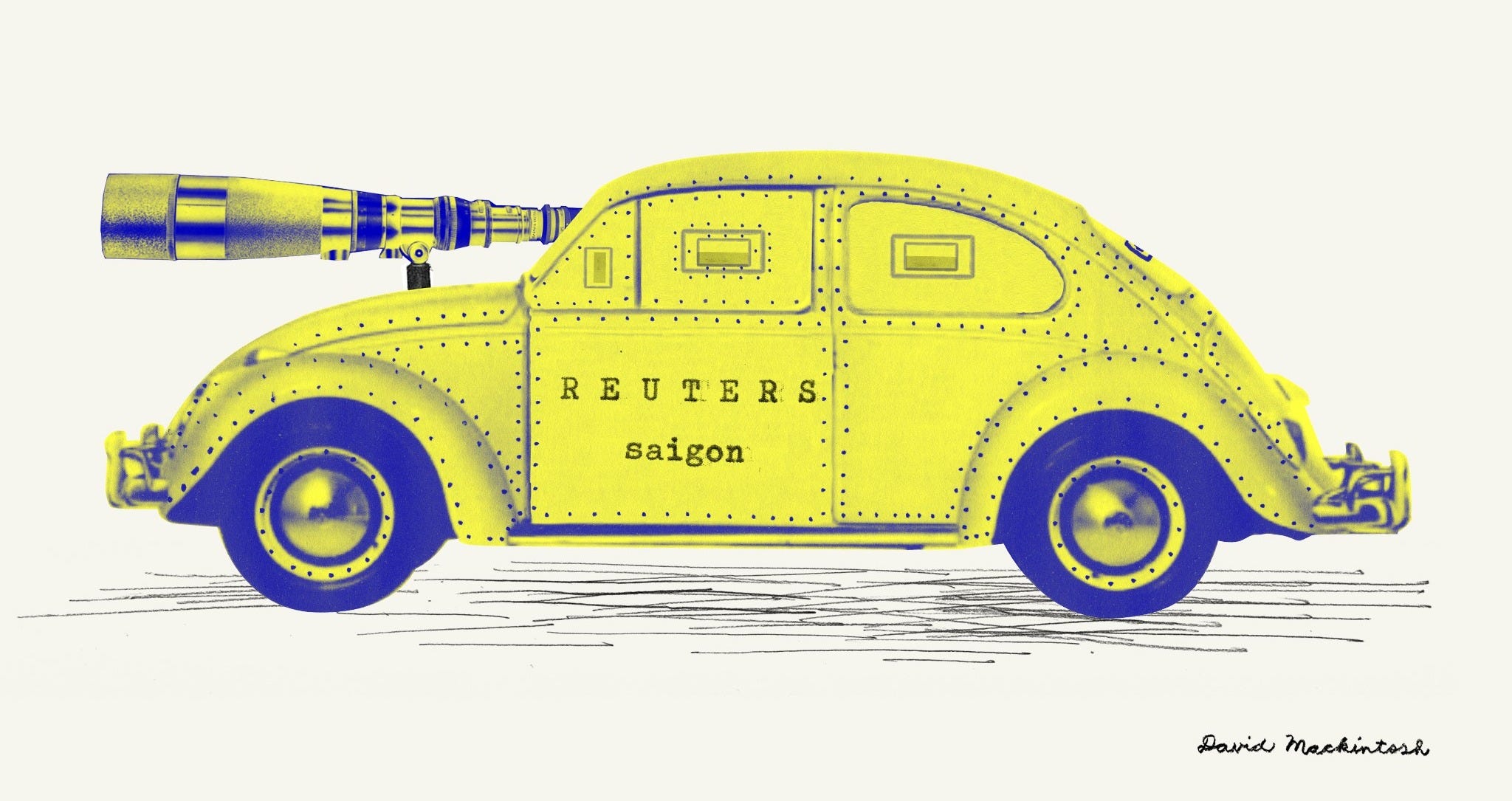
One afternoon in January 1968, I found myself facing the sort of decision you can only make if you’re going to keep it secret for the next 60 years.
And, if you’re happy never to get promoted.
My only excuse … there was a war on.
And I was suddenly confronted with a series of extraordinary, unpredictable, volatile, and unprecedented events.
These circumstances had left me alone in charge of the Reuters Bureau in Saigon at the height of the Vietnam War.
On my first overseas posting from London.
Reuters of 85 Fleet Street was the oldest and most trusted newsagency (wire service) in the world, supplying non-stop news to radio, television, stockbrokers, banks, and insurance companies.
Plus more than 6,000 metropolitan newspapers around the globe.
And now, right now, Saigon had erupted into the biggest story of 1968: for the first time ever, Viet Cong communist guerrillas were fighting their way through the streets in the centre of the city … creating chaos.
I was one of four Reuter war correspondents including our Bureau Chief, the experienced and famous Scottish war reporter, Jim Pringle.
Pringle normally placed one of us in the north of South Vietnam – 600 miles away – where the US Marines were fighting the North Vietnamese Army (NVA) … and kept two reporters in Saigon with him.
But American intelligence had warned that their most isolated base of Khe Sanh (near the junction of Laos and the border between North and South Vietnam) was surrounded by the NVA.
It was in danger of being over-run.
So Pringle sent a second correspondent north: leaving just two of us to provide 24-hour 7-day-a-week coverage of the war.
You might well think that a war correspondent’s job is purely to write stories.
But it’s actually much more than that.
After starting out using pigeons, Reuters had become the masters of fast international communications back in the era of Morse code and Telex.
So in the early 1960s Reuters decided to monetise “spare capacity” on their leased communication lines by also carrying the stories of major newspaper foreign correspondents.
At a fee.
This subsidised their expensive world-wide news operations.
After all, these newspaper foreign correspondents routinely finished their first-person, eye-witness, on-the-spot stories with “pick up agencies”: in other words, please background my story with additional material from Reuters, AP, UPI, or Agence France-Presse (AFP).
Plus, grab anything from them that has happened since.
This new Reuters entity was given the name “Special Services” and it soon signed up some 40 British and foreign newspapers.
These stories were referred to within Reuters as “Special Traffic”.
Clients included The Times of London, The New York Times, The Washington Post, Los Angeles Times, The Baltimore Sun, London Daily Mirror (the biggest-selling daily newspaper in the world at that time) the London Daily Express, Australian Associated Press (AAP) … and many others.
This lucrative new system worked really, really well … when nothing much was happening.
When something of worldwide interest occurred – such as the death of Franco in Spain in 1975 – Reuters flew in two extra telex operators from London just to handle the sudden flood of “Special Traffic”.
But did no one ever ponder how this would work if suddenly armed guerrillas were fighting on the street outside the Reuters Bureau; bullets bouncing off the footpath; a bullet hole in the brass Reuter sign?.
And, what if no one could get into or out of the capital?
As the Vietnam War grew bigger, in 1965 Reuters sent veteran London telex operator Wally Tuffin to supervise the flood of copy increasingly pouring into their Saigon Bureau.
Tuffin converted a room at the back of the office into a Telex Room with two telexes staffed by several local Vietnamese.
By the time I arrived in 1967, the Telex Room was headed by telex operators from Reuters’ South-East Asia HQ in Singapore ... on three-month turnarounds.
All stories went out on an international radio circuit which Reuters leased from South Vietnam’s Postes, Telegraphes et Telephones (PTT).
I came to know dozens of newspaper correspondents as they delivered their despatches by walking between our desks to the Telex Room.
One of them even chose to occupy a desk in our office – Bill Tuohy of the LA Times. Silver-haired and in his 40s, Bill sat quietly thinking, typing, and thumbing his well-worn Thesaurus.
He was by far the oldest man in the room.
He never said much to us. But I guess he enjoyed the background camaraderie of a busy office, where Jim Pringle would hang up the phone and call instructions to his staff: “Get down to …” “There’s a helicopter leaving for …” “An embargoed story’s just come in …”
Tuohy clearly preferred our office to a lonely hotel room.
There was another LA Times correspondent in Saigon, a loud friendly bloke who would bluster into the office clutching his “Special Traffic” story for the Telex Room.
But Tuohy didn’t speak to him much either.
Perhaps that’s why Tuohy was such an insightful and influential writer. When the military condemned the media for “only seeing pin-pricks of the war instead of the big picture”, Tuohy wrote: “But that big picture is dangerously out of focus”.
The head of The New York Times Bureau, Johnny Apple Jnr, often complained about the slowness of our Special Traffic because he expected his paper to receive priority. After all, he would say, they were paying big money for the service.
Because of his military-style crew-cut, TIME accurately compared Johnny Apple Jnr to “a slightly overweight West Point graduate”. But his astute brain – quickly pointing out errors at press conferences and asking difficult questions – made him a thorn in the military’s side.
I’d never heard the acronym SNAFU until I read a message Johnny Apple Jnr sent to The New York Times explaining the lateness of his story: “USUAL REUTERS SNAFU”.
The Telex Room would normally pass any criticism to Pringle for checking before transmission — but no one in the Telex Room knew that SNAFU translated in New York as: “Situation Normal All Fucked Up”.
In fact, stories were telexed out on a “first in, first out” basis: except that Reuter stories went first. After all, we were competing minute-by-minute with three other international newsagencies.
Over the years, Special Traffic correspondents had pressured or “encouraged” our telex operators to send their story first, so the door of the Telex Room displayed a huge sign: NO ENTRY.
So it was that after the Viet Cong invaded Saigon in their “panoramic” attack at the end of January 1968, foreign correspondents started bursting into our office waving fists-full of stories.
There was a lot happening.
Nineteen armed guerrillas shot their way into Saigon’s “Pentagon East”: the US Embassy fortress just along the street from us to the right. Guerrillas assaulted the Presidential Palace at the other end of our road, shouting “we have come to liberate the Palace: open the gates!”
Five VC attacked the Vietnamese-language Radio Saigon and five got inside planning to broadcast – so it was destroyed with artillery fire.
Saigon Airport was under attack and would be closed for weeks.
NVA tanks were now in the middle of the ancient imperial capital of Hue. Danang was under attack. Thirty-three of 34 province capitals were fighting for their future.
Yet America was supposed to be winning this war.
Martial Law was declared and a shotgun curfew imposed after dark. If a reporter needed to get somewhere, the US offered to drive them in a convoy of five jeeps with machineguns mounted on the bonnet.
US Military press conferences were now going for an hour and a half and had to be covered by Jim or me.
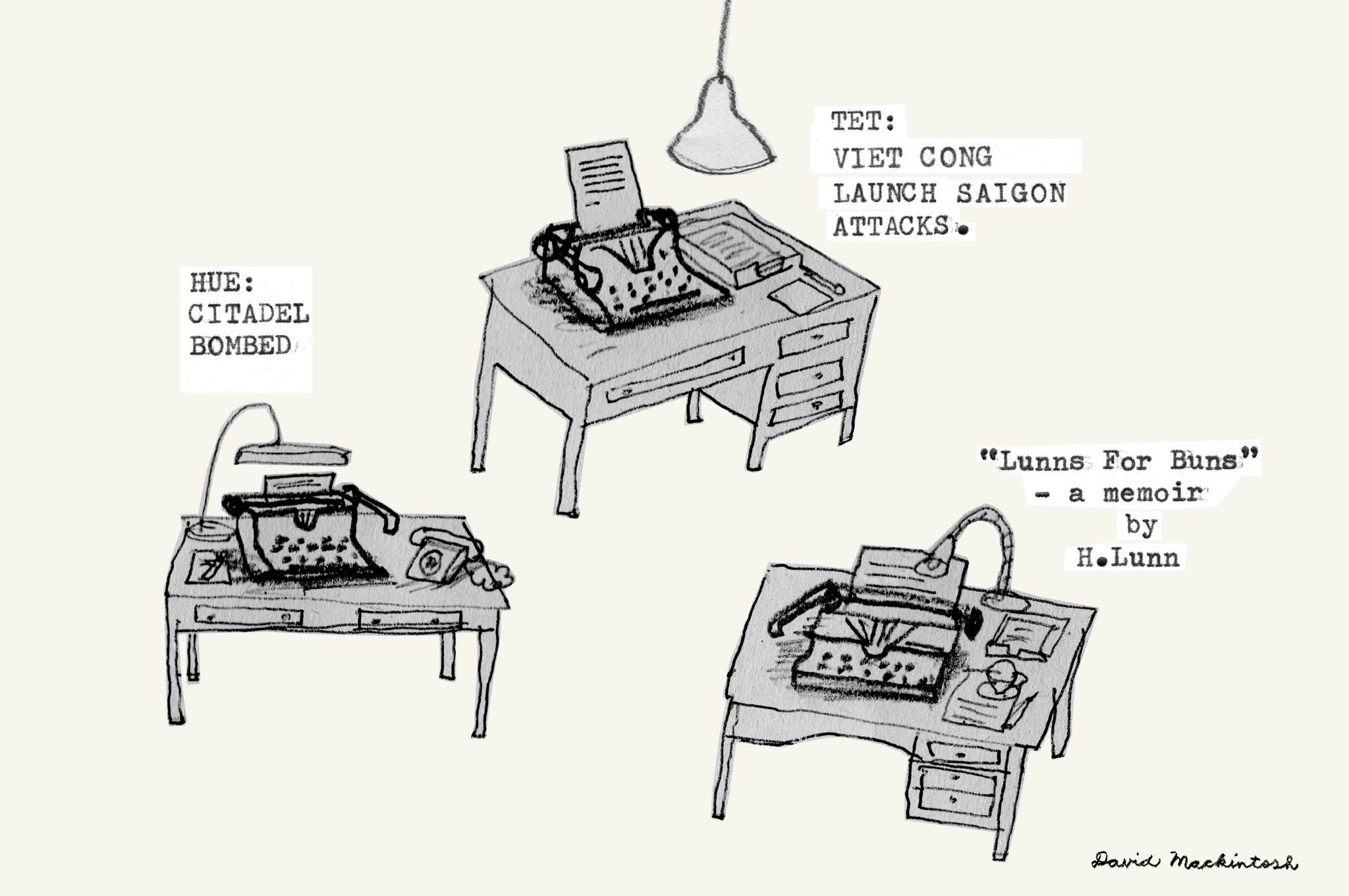
There were so many breaking stories that I found myself using three different desks and typewriters to write three urgent stories all at once … first paragraph of each; then second of each; and so on.
All shops were shut and a cordon thrown around 10 inner-Saigon blocks while South Vietnamese red beret troops searched each building.
Everyone was hungry.
That night, our telex communication failed: we knew this because we were receiving no messages from London.
Something had to be done.
Pringle set off in the office VW to the Cable Building where our incoming service first arrived, but was thwarted when a US jeep pointed its mounted machinegun through his window. (The VC had used private cars to catch US troops unawares and kill them.)
So at first light next day, I was sent with our Vietnamese office manager, Pham Ngoc Dinh, to try to reach the Cable Building, only to find it surrounded by barbwire and defended by South Vietnamese troops.
They levelled their rifles and would not allow us entry.
Dinh shouted to people in a window up on the seventh floor and they threw a rolled-up copy of our incoming service out the window, only just clearing the barbwire.
Urgent Saigon. Unheard for 11 hours! Hope you OK. Trying all avenues. Keep your heads down, one message said.
Our stories for the first 16 hours of this now infamous Tet Offensive had got through – but all our efforts of the previous evening had been wasted. The only way to fix what was wrong was to somehow get to PTT HQ three miles away with a bottle of scotch.
Pringle set off with Dinh while I prepared stories from all our efforts that had disappeared into the cosmos.
As usual, the bottle of scotch worked.
But, as they were leaving, the office VW came under fire from atop a building. Jim and Dinh jumped out while the car was still moving.
A policeman who signalled them to run to him was shot through the hand.
Jim and Dinh were pinned to the ground in the middle of an ambush … meanwhile back in the office I took copy from radio-phones. Bruce Pigott, in Khe Sanh, and John MacLennan, in Hue, who reported that the Americans were bombing the Citadel.
I did this with the phone handle held to my left ear by my shoulder.
After a few hours I began to get an uneasy feeling that I was now covering this war on my own.
Then, just as I thought things had hit rock bottom, out from the Telex Room at the back walked Alan Lee – a Chinese telex operator from Singapore – with tears in his eyes.
He was holding out his hands, fingers tightly curled up in both palms.
“I can’t type anymore,” Alan told me.
During all the battles of the last two days we’d forgotten about Alan as he worked without stop or complaint to try to clear the overflowing Telex Room baskets full of Special Traffic.
This was because all correspondents (including us) were writing longer and more stories, yet none of our Vietnamese telex operators had been able to get to the office through the cordon thrown around the inner-city.
Alan had tried mightily to keep up with what was an impossible task for one man.
Operating a Telex machine – which punches out a white paper tape full of holes – is a slow and complex rhythmic business totally different from typing. The tape is then inserted in the auto-head which can only transmit at a maximum of 60 words a minute.
Alan needed a break – yet his IN baskets overflowed with stories written for newspapers around the world desperate for their own reports.
We were the channel for these famous foreign correspondents. They were depending on us … not knowing what we were up against.
Alan lay down while I pondered what to do.
Clearly, I couldn’t throw away the work of any of the Special Traffic journalists. Yet there was no way all, or even many, of these stories were going to get through.
I wished Jim Pringle were here – but where was he? Was he ever coming back?
So I made a decision.
I took each unsent story in my hands and tore off and threw away everything except the first page … and wrote “Pick up agencies” at the bottom.
I was throwing away the work of some of the world’s top journalists. Words that had been gathered perhaps by reporters under fire or crawling across a road … But this way, some 200 words from each correspondent would be transmitted.
His own words: with his by-line.
Jim Pringle and Dinh eventually made it back into the office, rushing in covered in dirt and without the office VW.
They had been through Hell.
Jim stood and stared down the long corridor through his Coke bottle glasses. Dinh ran to me and said: “I think I die! I think I die, Gunsmoke!” … laughing and crying at the same time.
“I think I never to see my children again!
“The bullets go over my head. I crawl behind a tank, but Jim say No, they have rockets! I look at Jim. He crawls in one direction, then another one. But each way, bullets. I try to tell Jim something, but nothing comes. I want to tell him, Look after my wife and sons, and that when they grow big, not be journalists.”
I couldn’t bring myself to tell Pringle what I had done in his absence. He had enough on his plate.
It should have been his decision, and — still today — I have no idea what he would have done.
All I knew was that what I had done was a sackable offence.
David Mackintosh illustrations © profuselyillustrated.com
My brother, Andrew, lives in Vietnam and is looking forward to Tet, 2026. He is a war historian/author and ex-Army Reserve, so he knows all about 1968. But I will put him onto your website.
Steve Ricketts
... and this
Vietnam: The day the war was lost
by Hugh Lunn
18 January 2018
https://archive.md/lMabW
No credits for the photos. Are they yours?